
What is the connection between psychedelics, spirituality, and mystical experiences?
Introduction: The Gateway to the Sacred
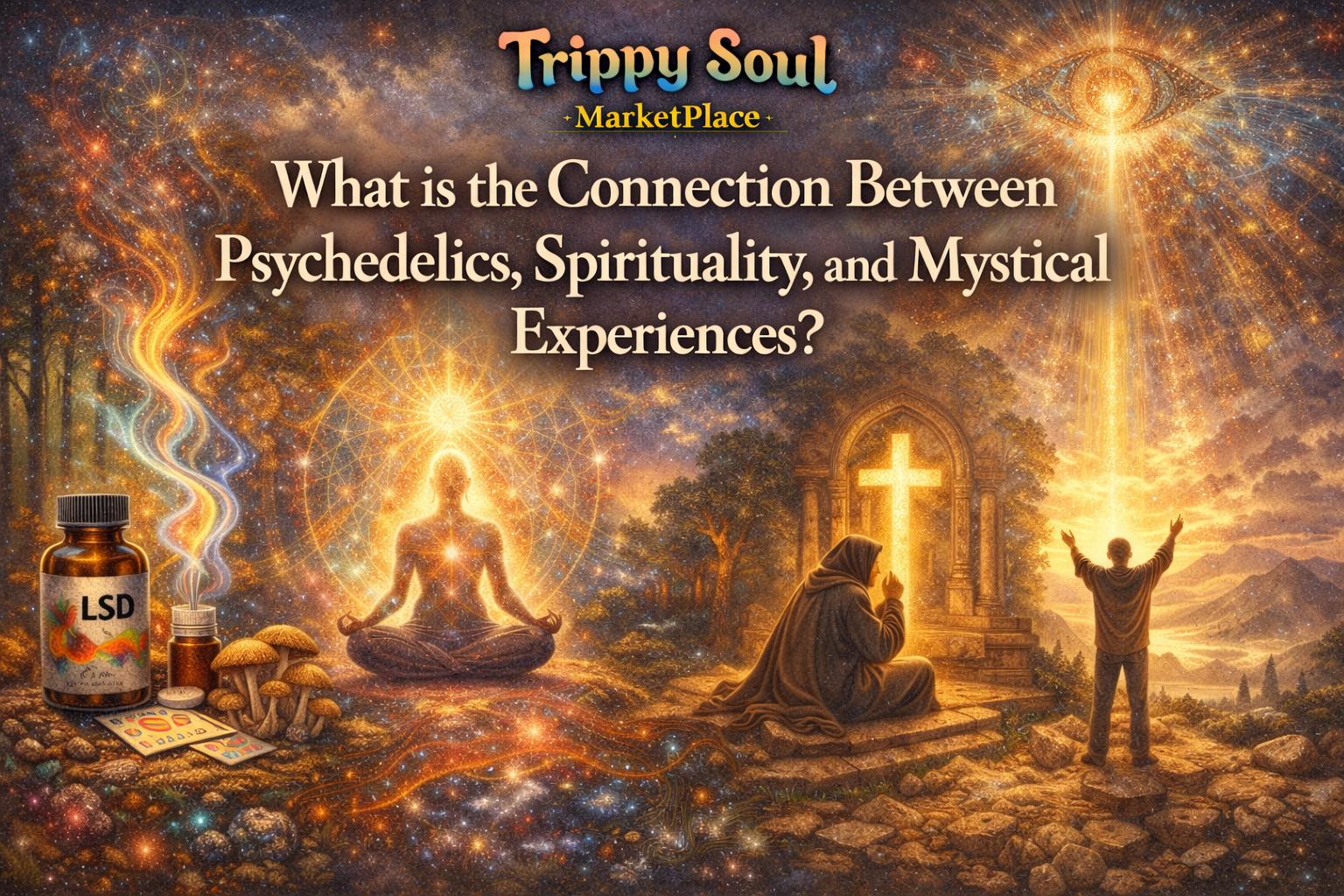
What is the connection between psychedelics, spirituality, and mystical experiences? This profound question links modern neuroscience with ancient human yearning. Across cultures and centuries, people have sought transcendence—a connection with something greater than themselves. Today, powerful tools have re-emerged in this ancient search. Substances like psilocybin, LSD, and ayahuasca act as catalysts. They reliably induce states of consciousness that individuals universally describe as deeply spiritual or mystical. These experiences feature sacredness, profound unity, and transcendent knowledge. This guide will explore this essential connection. First, we will define mystical states through a modern lens. Next, we will examine groundbreaking scientific research that measures the ineffable. Furthermore, we will investigate how these chemically-facilitated experiences compare to spontaneous spiritual epiphanies. Finally, we will consider the implications for personal growth and our conception of reality. The link between psychedelic molecules and core mystical experience may be one of the most significant discoveries of our time.
Defining the Ineffable: What is a Mystical Experience?
First, we must define our terms. Spiritual and mystical experiences often sound vague. However, researchers have developed precise frameworks to describe them. Psychologist William James, in his seminal work The Varieties of Religious Experience, outlined four key marks of the mystical.
First, there is Ineffability: The experience defies full expression in words. Second, there is Noetic Quality: It feels like a state of revelation into deep truth. Third, we have Transiency: The peak state is temporary, though its effects persist. Fourth, there is Passivity: The individual feels as if a superior power has gripped them.
Building on this, contemporary researchers use tools like the Mystical Experience Questionnaire (MEQ). This scale measures core dimensions such as Unity, which is a sense of merging with all things. It also measures Sacredness, which is a feeling of profound reverence. Additionally, it assesses Noetic Quality, the conviction of gaining direct, intuitive knowledge. The scale also looks at the Transcendence of Time and Space and a Deeply Felt Positive Mood of joy and peace.
Therefore, a “mystical experience” is not a vague feeling. It is a specific, measurable state of consciousness. This state has profound and lasting psychological impact. Importantly, this state can arise spontaneously through meditation or prayer. It can also emerge through the intentional use of psychedelic substances.
The Scientific Evidence: Psilocybin and the “God Molecule”
The modern connection between psychedelics and mysticism is not just anecdotal. It is the subject of rigorous laboratory science. The most famous research comes from Johns Hopkins University and NYU.
The Methodology and Results: Researchers conducted these trials in a carefully controlled setting. They used comfortable rooms with spiritual aesthetics. Soothing music played. Trained guides provided support. The participants received either a high dose of psilocybin or an active placebo. The results were staggering.
Over 70% of participants in the high-dose groups rated their psilocybin session as among the top five most spiritually significant experiences of their lives. Approximately one-third called it the single most meaningful experience.
Furthermore, researchers correlated the intensity of the mystical experience with the positive long-term outcomes. Specifically, the higher an individual scored on the MEQ, the greater their reductions in depression and anxiety. They also showed more significant increases in life satisfaction and altruism. This research provided a crucial insight.
The therapeutic benefit appears deeply intertwined with the spiritual or mystical component. The medicine does not just alleviate symptoms; it can facilitate a transformative encounter with the sacred.
The Neurological Bridge: How Do Psychedelics Create These States?
To understand the connection, we must look at the brain. Neuroscientists propose that mystical states involve a temporary dissolution of the ordinary self. Psychedelics facilitate this neurobiologically.
The key player is the Default Mode Network (DMN). This is a network of brain regions associated with your sense of self. It is the brain’s “orchestra conductor” for the ego. In conditions like depression, the DMN is often hyperactive, trapping individuals in rigid, negative thought loops.
Psychedelics like psilocybin temporarily quiet the DMN. This allows for a state of hyper-connectivity between brain regions. The result is what neuroscientist Robin Carhart-Harris calls the “entropic brain” state.
This neurological shift directly maps to the mystical experience. Quieting of the DMN equals Ego Dissolution. This is the loss of the everyday sense of self. Hyper-connectivity equals a Sense of Unity. This is the feeling of merging with people or the cosmos. Increased Entropy equals Novel Insights. The breaking of rigid patterns allows for new, “noetic” ideas to emerge.
Thus, psychedelics provide a chemical key. They unlock a neurobiological state that is the substrate for mystical consciousness. Consequently, the brain becomes temporarily rewired to perceive unity instead of separation.
Comparison: Psychedelic vs. “Natural” Mystical Experiences
A critical question arises: Are psychedelic mystical experiences “real” or just drug-induced illusions? This is a false dichotomy. The evidence suggests they are phenomenologically identical to spontaneous mystical states.
Similarities: Individuals report the same core features: unity, sacredness, ineffability, and positive transformation. Brain imaging studies of experienced meditators show similar reductions in DMN activity. The subjective reports from a monk and a psilocybin participant are often indistinguishable.
Differences: The primary differences lie in reliability, accessibility, and context. First, Reliability: A high dose of psilocybin can reliably induce a mystical state. Reaching similar depths through meditation may take decades. Second, Accessibility: Psychedelics can provide a “shortcut” for those without a contemplative practice. Third, Context: The framing is crucial. A spontaneous experience may fit an existing religious framework. A psychedelic experience might be interpreted in more secular terms.
Ultimately, the brain state appears to be the common denominator. The catalyst—whether meditation or a molecule—can vary.
The Role of Set, Setting, and Intention
The connection is not purely pharmacological. The famous principle of “set and setting” is paramount here. Set is your mindset. Setting is your environment.
Administer psilocybin in a sterile lab, and you may get a paranoid experience. Conversely, administer it in a beautiful, safe room with a spiritual intention, and you increase the likelihood of a mystical encounter. Therefore, the substance is the catalyst, but the container shapes the experience. This is why indigenous traditions use these substances within elaborate rituals.
Implications and Transformative Potential
This connection carries immense implications for individuals and society.
1. Personal Transformation and Healing: These experiences can catalyze profound personal change. Individuals often report a decreased fear of death. They also note an increased sense of purpose and greater compassion. The experience provides a direct, felt sense of being part of a larger whole. Consequently, this can heal existential despair.
2. The Demystification of Religion: Psychedelics can separate the core mystical experience from specific religious dogmas. They provide direct access to the experience of the sacred. For some, this strengthens their existing faith. For others, it leads to a more universal perspective. Thus, it challenges institutional authority while validating the mystical impulse.
3. Ethical and Philosophical Questions: If divine unity can be induced by a molecule, what does that say about spirituality? Many argue the brain is a filter of consciousness. Psychedelics temporarily widen this filter. This debate touches on the hard problem of consciousness itself.
4. Risks and Shadow Sides: The spiritual potential carries risks. These include spiritual bypass—using insights to avoid psychological work. There is also the risk of inflation. Therefore, integration is crucial to ground the insights into everyday life.
Voices from the Experience: Anecdotes and Testimonies
Beyond the data, personal narratives illuminate the connection. Many describe encounters with a benevolent intelligence. Others speak of merging into a boundless ocean of love. Cancer patients report losing their fear of death. Veterans describe finally feeling forgiveness. These stories consistently highlight themes of unconditional love and peace. These are the classic hallmarks of the mystical.
Conclusion: Reconnecting with the Numinous
So, what is the connection between psychedelics, spirituality, and mystical experiences? It is a profound and empirically validated link. Psychedelics can reliably induce a state of consciousness characterized by ego dissolution and sacred unity. Neurologically, this correlates with a temporary quieting of the Default Mode Network.
This connection suggests that the capacity for mystical experience is a natural human trait. Psychedelics are one powerful key to unlocking this capacity. They do not create something foreign but reveal something innate. They offer a bridge between neuroscience and spirit.
This discovery does not diminish spirituality. Instead, it grounds it in human biology. It suggests that the search for the sacred is an exploration of reality’s deepest layers. As we continue to study this connection, we may foster a more direct and unifying spirituality for our time. Ultimately, wonder and sacred connection are biological potentials waiting to be awakened. psychedelics, spirituality, and mystical experiences?