
1cP-LSD Blotter: What It Is, How It Differs From LSD, and What the Research Shows
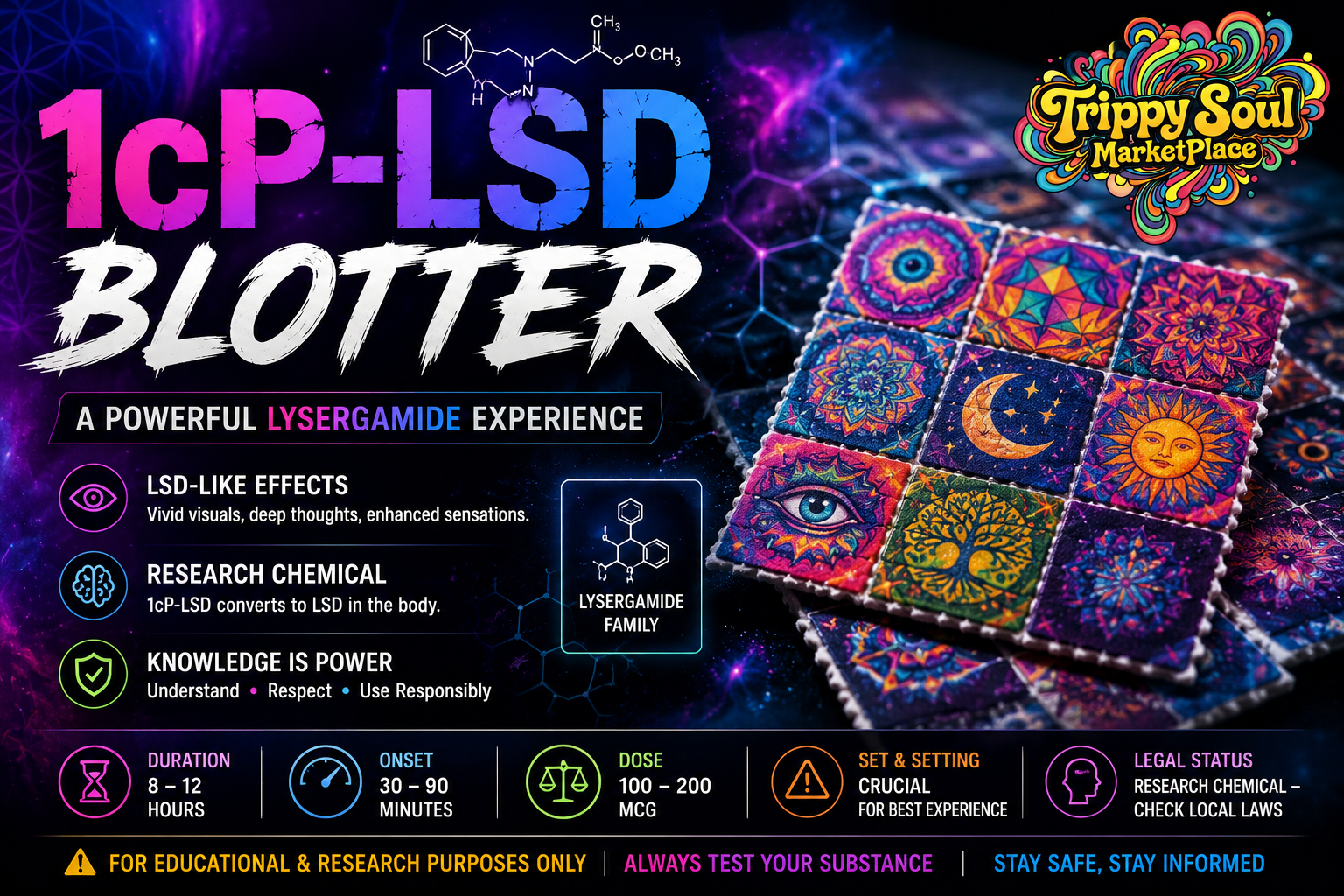
Blotter paper printed with tiny colorful designs has represented LSD culture for decades, and now a newer compound has started showing up on that same paper: 1cP-LSD. Consequently, a lot of people encounter 1cP-LSD blotter without understanding what actually separates it from classic LSD, or what makes it a distinct category of research chemical in the first place. Therefore, this guide walks through the chemistry, legal status, effects profile, and general harm reduction context surrounding 1cP-LSD blotter, based on available research and drug-checking data.
Importantly, this article will not provide dosing or administration instructions. Instead, it focuses on what 1cP-LSD actually is, how it compares to LSD, and what current evidence says about its risks, because informed decisions depend on accurate information rather than internet rumor.
What Is 1cP-LSD?

1cP-LSD, or 1-cyclopropionyl-lysergic acid diethylamide, belongs to a family of LSD analogs that chemists began synthesizing after earlier compounds like 1P-LSD faced legal restrictions in various countries. Structurally, 1cP-LSD carries a cyclopropionyl group attached to the LSD molecule’s indole nitrogen. Because of that added group, researchers classify it as a prodrug, meaning the body metabolizes it into active LSD after ingestion. As a result, 1cP-LSD effects and classic LSD effects overlap substantially, since the body converts one into essentially the other.
Chemists and gray-market vendors originally developed 1cP-LSD, along with similar analogs, as a legal research chemical alternative in jurisdictions where LSD itself carried strict scheduling but newer analog compounds had not yet been explicitly named in law. Nevertheless, several countries have since moved to schedule 1cP-LSD directly, given its close relationship to LSD, and enforcement continues to shift as legislation catches up with the compound’s spread.
Why Blotter Paper Specifically?
Historically, LSD culture adopted blotter paper because it offers a convenient, discreet, and easily divided distribution format. Following that same tradition, 1cP-LSD blotter has become one of the most common ways vendors distribute the compound, alongside pellets and liquid solutions. Typically, a sheet gets perforated into small squares, each printed with decorative artwork, and each square theoretically carries a measured amount of the compound.
However, this format creates a genuine consistency problem worth understanding. Since blotter production happens largely outside regulated pharmaceutical settings, the amount of active compound on any individual square can vary meaningfully from sheet to sheet, and even from square to square within the same sheet. Therefore, appearance, color, or printed design tells a buyer nothing reliable about potency or purity, similar to how tusi’s pink color reveals nothing about its actual contents.
1cP-LSD vs LSD: Key Differences
| Category | LSD | 1cP-LSD |
|---|---|---|
| Chemical relationship | The original, directly active compound | A prodrug that converts into LSD inside the body |
| Legal status | Scheduled directly in most countries | Scheduled in a growing number of countries, still ambiguous in others |
| Onset | Documented and relatively well understood | Believed to have a slightly longer onset due to the metabolic conversion step |
| Market history | Circulating since the 1960s | Emerged more recently as an analog developed after 1P-LSD faced restrictions |
| Purity consistency | Varies by source, but well-studied historically | Varies significantly, with less regulatory oversight and fewer long-term studies |
| Common formats | Blotter, liquid, microdots | Blotter, liquid, pellets |
Comparing 1cP-LSD Effects to Classic LSD
Because 1cP-LSD converts into LSD within the body, user reports and the limited available research suggest that 1cP-LSD effects closely resemble those of classic LSD once the conversion process completes. Commonly reported effects include visual distortions, altered time perception, mood shifts, and heightened sensory experience. Meanwhile, some users report a marginally slower onset compared to LSD, which researchers attribute to the extra metabolic step required to strip away the cyclopropionyl group.
Still, meaningful differences in individual experience can emerge, given that 1cP-LSD hasn’t undergone anywhere near the volume of scientific study that LSD has received over more than sixty years. Consequently, claims about 1cP-LSD being “gentler” or “cleaner” than LSD remain largely anecdotal rather than evidence-based, and researchers caution against treating anecdotal reports as a substitute for controlled study data.
Risk Considerations
Every compound discussed here carries real risk, and nobody should treat any of them as inherently safe. That said, a few specific risk factors deserve attention.
First, because 1cP-LSD blotter production happens without pharmaceutical-grade quality control, potency inconsistency represents a genuine concern, since a buyer generally cannot know how much active compound a given square actually contains. Second, since 1cP-LSD functions as a research chemical, published toxicology and long-term safety data remain considerably thinner than the decades of research behind LSD itself. Third, psychological risk factors that apply to LSD apply equally here, including the potential for anxiety, panic reactions, and complications for anyone with a personal or family history of psychosis or certain psychiatric conditions.
Additionally, mixing any lysergamide, including 1cP-LSD, with other substances, particularly other serotonergic drugs or certain prescription medications like MAOIs, can create dangerous interactions. For that reason, anyone taking prescription medications should consult a doctor or pharmacist about potential interactions before making any decisions involving 1cP-LSD or related compounds.
Legal Status Around the World
Legal treatment of 1cP-LSD varies considerably by country and continues to evolve. Several European countries have explicitly scheduled it following the same pattern used against 1P-LSD, treating it as a controlled analog of LSD. In the United States, federal analog laws can potentially apply to 1cP-LSD given its structural similarity to LSD, even in states where it hasn’t been explicitly named, though enforcement and interpretation vary by jurisdiction. Consequently, anyone considering the legal status of 1cP-LSD blotter in their region should treat “not explicitly named in law” as legally uncertain rather than legally safe, since prosecutors in many places can pursue analog or research chemical statutes regardless of explicit naming.
Why Drug Checking and Sourcing Awareness Matter
Because potency on 1cP-LSD blotter varies so significantly, and because misrepresented or contaminated products circulate within gray-market research chemical spaces, drug-checking services and community testing resources have become increasingly important. These services cannot eliminate risk entirely, and no test provides a complete potency reading for LSD-family compounds using typical home reagent kits. Still, reagent testing can at least confirm the general chemical family present, which offers meaningfully more information than blotter artwork or a vendor’s marketing claims.
Where available, community drug-checking organizations publish alerts about misrepresented research chemicals, including cases where products sold as 1cP-LSD actually contained something else entirely, or nothing psychoactive at all. Following those alerts, wherever your region provides access to them, represents one of the most practical steps available for anyone trying to understand what’s actually circulating locally.
Frequently Asked Questions
Is 1cP-LSD the same as LSD? Not exactly, though they’re closely related. 1cP-LSD functions as a prodrug that the body converts into LSD, so the active compound ultimately experienced is chemically identical to LSD itself, even though the substance ingested initially differs.
Are 1cP-LSD effects weaker than LSD? Not necessarily. Instead, once metabolic conversion completes, reported 1cP-LSD effects closely track LSD’s known effects profile, although onset may take somewhat longer.
Is 1cP-LSD legal? It depends entirely on jurisdiction. Some countries have scheduled it explicitly, while others rely on broader analog laws that may or may not apply, so “not explicitly named” should never be mistaken for “confirmed legal.”
Does blotter format affect potency consistency? Yes, significantly. Since blotter production occurs outside regulated pharmaceutical settings, potency can vary considerably between sheets and even between individual squares from the same sheet.
How is 1cP-LSD different from 1P-LSD? Both function as prodrugs that convert into LSD, differing mainly in the specific chemical group attached to the molecule. However, 1P-LSD faced earlier legal restriction in several countries, which is part of why 1cP-LSD emerged as a newer alternative on the research chemical market.
General Harm Reduction Principles
While this article intentionally avoids dosing or administration advice, several broader harm reduction principles apply regardless of the specific lysergamide involved. First, never use alone, since having a sober, trusted person present matters enormously if something goes wrong. Second, remember that blotter artwork and vendor branding function as marketing rather than chemical guarantees, and neither reveals anything reliable about actual potency. Third, stay aware of medication interactions, particularly with antidepressants or other psychiatric medications, and consult a doctor or pharmacist about specific risks. Fourth, learn the signs of a psychological or medical emergency, and don’t hesitate to seek help, since medical amnesty or Good Samaritan laws protect callers in most places. Finally, consider that a personal or family mental health history, particularly one involving psychosis, can meaningfully shape how a lysergamide compound affects someone.
The Rise of 1cP-LSD as a Research Chemical
Interestingly, 1cP-LSD’s emergence follows a pattern that’s been repeated across the wider LSD research chemical market for over a decade now. When 1P-LSD was scheduled in the United Kingdom, several EU countries, and eventually elsewhere, gray-market chemists were pushed toward synthesizing structurally similar alternatives that hadn’t yet been named in existing law. As a result, some vendors developed 1cP-LSD and introduced it to the market, marketing it as a legal LSD research chemical even in regions where its legal status was, at best, untested.
This pattern is sometimes described as “analog chasing,” where legislation targets a specific named molecule, and a slightly modified molecule is synthesized in response, only for that new molecule to eventually be scheduled as well. Consequently, lawmakers tend to shrink the legal window during which vendors can market any given LSD research chemical analog as unscheduled, since they increasingly write broader analog statutes rather than naming individual compounds one at a time.
Vendors selling 1cP-LSD blotter have generally marketed it toward two overlapping audiences: people specifically seeking a product believed to be legally distinct from LSD, and people who simply couldn’t access LSD itself through their usual sourcing channels. Either way, the compound’s close relationship to LSD, rather than any documented advantage in safety or effects, largely drives its popularity.
The Bottom Line
People often treat 1cP-LSD blotter as functionally identical to classic LSD blotter, and in terms of the compound the body ultimately produces, that assumption carries some truth. However, meaningful differences remain in legal status, research depth, and production consistency, all of which matter for anyone trying to make an informed decision. Recognizing 1cP-LSD as a related but distinct research chemical, rather than simply “LSD under a different name,” provides a clearer and more accurate foundation for understanding its risks.
If you or someone you know struggles with substance use, organizations like SAMHSA’s National Helpline (1-800-662-4357, available 24/7 in the U.S.) offer free, confidential support and can connect callers with local resources.
This article serves educational purposes only and does not constitute medical or legal advice. Always consult a qualified healthcare professional or legal expert regarding any substance use or legal concerns.