
1P-LSD Online: The Real Risks Behind Every Purchase
Table of Contents
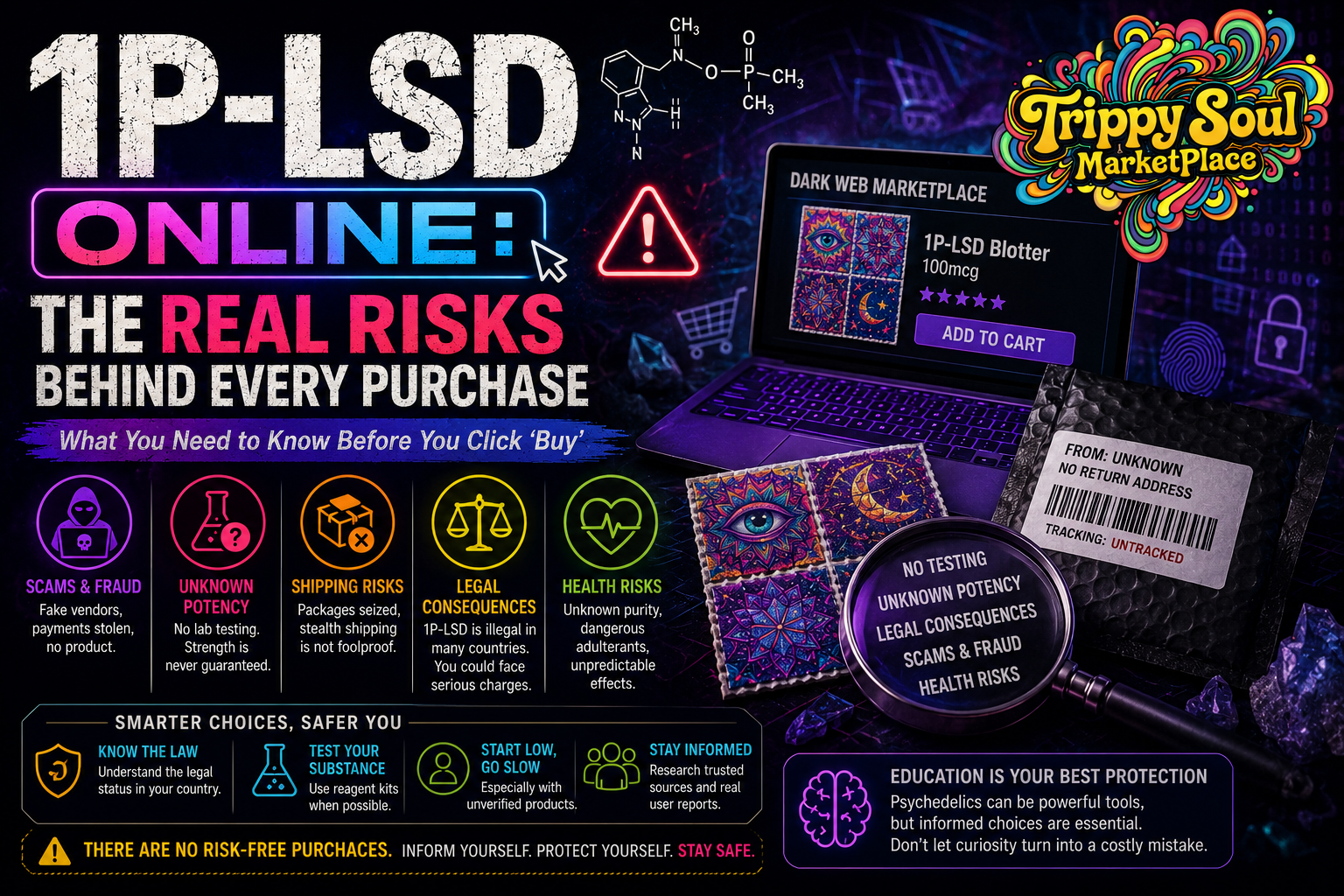
Searching for 1p-lsd online turns up an entire ecosystem of research chemical vendors, forums, and marketplaces, most of which look far more professional and trustworthy than they actually are. That gap between appearance and reality is exactly what this guide addresses. Rather than a shopping guide, this is a risk breakdown: what buying 1P-LSD online actually involves legally, how the vendor landscape works, and what genuine harm reduction looks like for anyone already researching the topic.
What “1P-LSD Online” Actually Means
The phrase 1p-lsd online generally refers to a scattered network of independent websites, some based in countries with looser research chemical laws, selling lysergamide analogs directly to consumers. Unlike a typical online retailer, there’s no unified regulatory body checking product quality, verifying vendor claims, or holding anyone accountable when something goes wrong. Each site essentially operates on its own reputation, built through forum reviews and word of mouth rather than independent oversight.
Because this market exists largely outside conventional regulation, it behaves very differently from ordinary e-commerce. Sites can appear, rebrand, or disappear entirely within months, sometimes taking customer payments with them. Vendors that seem established today can vanish tomorrow, particularly if a country tightens its laws or a payment processor cuts ties. That instability alone should shape how anyone thinks about buying from this space.
Why Prices Vary So Wildly Across Vendors (Buying 1P-LSD Online)
Anyone comparing 1p-lsd online listings quickly notices huge price swings between sites offering what looks like the same product. Part of that gap comes down to legitimate differences in sourcing, purity claims, and shipping origin. However, a large part of it comes down to something less reassuring: undercutting through dilution, outright substitution, or simply pricing low to attract buyers before disappearing with their payment.
Because there’s no independent body verifying what any given price actually reflects, cost alone tells a buyer almost nothing about quality. In fact, unusually low prices are one of the more reliable warning signs in this market, precisely because legitimate sourcing and testing cost money that scam operations skip entirely. Meanwhile, higher prices don’t guarantee legitimacy either, since a well-designed scam site can charge premium rates while offering nothing real behind the listing.
As a result, price comparison across 1p-lsd vendors is a far weaker signal than buyers often assume. Forum reputation built over years, combined with independently published lab results, tends to matter more than any number on a listing page. That said, even long-standing vendors have been known to change practices, get compromised, or exit-scam after building trust for exactly that purpose, which is why no single signal should be treated as a guarantee.
Is It Legal to Buy 1P-LSD Online?
The honest answer is that it depends heavily on where you live, and the situation shifts constantly. In several countries, including Germany and others that have added 1P-LSD to their New Psychoactive Substances legislation, purchasing it is explicitly illegal regardless of where the seller is based. In the United States, 1P-LSD isn’t always named directly in federal scheduling, but the Federal Analogue Act can still apply because regulators can treat it as substantially similar to LSD, a Schedule I substance.
That legal ambiguity creates a dangerous assumption for buyers: that because a website operates openly, the purchase itself must be legal. It rarely works that way. Customs and mail authorities in many countries actively screen international packages for exactly this category of substance, and a seller operating legally in their own country doesn’t protect a buyer receiving the package somewhere with stricter laws. Consequently, the legal risk in an online 1P-LSD purchase often sits entirely with the buyer, not the seller.
Because enforcement priorities and legislation both change over time, anyone researching this topic should verify current local law directly rather than trusting outdated forum threads or vendor claims, since vendors have an obvious financial incentive to describe legality in the most reassuring light possible.
The Vendor Problem: Why Online Markets Are Risky
Unlike a pharmacy or a licensed retailer, research chemical vendors face essentially no independent verification of what they claim to sell. A listing might state a precise concentration or purity percentage with total confidence, yet that number often traces back to nothing more than the vendor’s own internal testing, if any testing happened at all. Buyers are, in effect, trusting a stranger’s word about a product with real physiological effects.
This lack of accountability shows up in predictable ways. Some vendors mislabel products, whether through carelessness or deliberate substitution with something cheaper. Others simply disappear after receiving payment, a pattern common enough that dedicated forum threads exist purely to track which sites are currently considered scams. Because reputation is the only real currency in this market, and because reputation can be faked with a handful of paid reviews, buyers have far less protection than they might assume from a professional-looking website.
Payment methods add another layer of risk. Many vendors accept only cryptocurrency specifically because it’s harder to trace and impossible to charge back, which also means a buyer has essentially no recourse if a package never arrives or arrives with the wrong contents. That absence of buyer protection is a structural feature of this market, not an occasional failure.
Red Flags Worth Knowing
Certain patterns show up repeatedly among the riskiest vendors, and recognizing them matters for anyone navigating this space regardless of intent. Prices dramatically lower than the rest of the market often signal a scam, a diluted product, or an outright substitution. Vendors that pressure urgency, such as countdown timers or claims of limited stock, are using standard scam psychology borrowed directly from conventional e-commerce fraud.
A total absence of any independent lab testing is another significant warning sign, especially when a site makes strong purity claims without offering any way to verify them. Similarly, brand-new websites with no forum history, no independent reviews, and unusually polished marketing copy deserve real skepticism, since building genuine trust in this space typically takes years, not weeks.
Product Safety Risks With 1P-LSD Purchased Online
Even when a vendor is operating in good faith, the underlying product carries real uncertainty. Because 1P-LSD synthesis happens outside regulated pharmaceutical facilities, purity and concentration can vary considerably between batches, and sometimes within the same batch. Blotter paper, the most common format, compounds this problem further, since uneven soaking during production means one square can carry meaningfully more or less compound than its neighbor.
Reagent testing kits can offer some reassurance after a product arrives, but they weren’t designed to confirm exact concentration, and a positive color reaction doesn’t rule out contamination or mislabeling entirely. Independent lab testing services exist and can provide far more reliable verification, though that step requires additional time, cost, and a willingness to send a sample away before using the rest.
Mislabeling remains a documented problem across this market generally. Products sold as 1P-LSD have occasionally turned out to contain a different lysergamide, an inactive substance, or in rarer but more serious cases, something considerably more dangerous. That uncertainty is precisely why buying anything in this category carries risk that has nothing to do with the chemistry of 1P-LSD itself.
Legal Risks: Customs, Mail, and Prosecution
International shipping adds a layer of risk that’s easy to underestimate. Customs authorities in many countries routinely screen packages using both physical inspection and increasingly sophisticated detection methods, and intercepted packages can trigger anything from simple confiscation to a formal investigation, depending on the country and the quantity involved.
Because mail interception can lead to a knock on the door rather than just a lost package, buyers sometimes face legal consequences even in places where the substance itself sits in a gray area. Prosecutors can also apply broader analogue or psychoactive substance laws in cases where the specific compound isn’t named explicitly, meaning “not directly scheduled” offers far less protection than it might seem to online. Anyone weighing this risk should understand that legal exposure often extends well beyond simple possession, particularly if quantities suggest distribution rather than personal use.
Harm Reduction If You’re Researching 1P-LSD Online
Given everything above, a few habits meaningfully reduce risk for anyone determined to research this space regardless of the legal picture. Prioritizing vendors with a long, independently verifiable track record and published third-party lab results reduces the odds of an unexpected or mislabeled product significantly. Reading recent, specific forum feedback matters more than star ratings or testimonials hosted directly on a vendor’s own site, since those are trivially easy to fabricate.
Furthermore, spreading trust across a single order rather than a large one limits potential loss if something does go wrong with a new or unfamiliar source. In addition, keeping personal information separate from payment details, where legally possible, reduces exposure if a vendor’s records are ever compromised or seized.
Testing anything that arrives, using reagent kits at minimum and independent lab verification where possible, catches many of the most dangerous mismatches before use. Never using alone, and keeping a sober, trusted person present, remains one of the simplest and most effective safety measures available regardless of where a substance came from. Understanding local law before a package ever ships, rather than after a problem arises, avoids a category of risk that has nothing to do with the substance itself.
Anyone with a personal or family history of psychosis, certain heart conditions, or uncontrolled high blood pressure should treat that history as a serious reason for added caution with any lysergamide, since these experiences can worsen underlying conditions unpredictably. If something goes wrong, seeking medical help immediately matters more than any legal concern, and many regions have Good Samaritan protections specifically designed to encourage exactly that call.
Frequently Asked Questions
Is buying 1p-lsd online illegal? It depends entirely on your country and sometimes your state or province. Some places have banned it explicitly, others rely on broader analogue laws, and enforcement varies considerably. Checking current local regulations directly is essential before assuming anything.
Are 1p-lsd vendors regulated in any way? No formal, universal regulation exists. Reputation, forum history, and independent lab testing are the closest things to verification in this market, and even those can be manipulated or faked.
What are the biggest 1p-lsd online risks? Legal exposure through customs and mail interception, product mislabeling or contamination, and vendor scams involving cryptocurrency payments with no buyer protection are the three most commonly reported risks.
Is it safe to buy 1p-lsd online if a vendor has good reviews? Good reviews reduce but don’t eliminate risk. Reviews can be fabricated, vendors can change practices over time, and even a reputable seller can’t guarantee what customs authorities or local law will do with a package once it ships.
Conclusion
Ultimately, 1p-lsd online purchases sit at the intersection of legal uncertainty, an unregulated vendor market, and a product whose purity can never be fully guaranteed before it arrives. None of that uncertainty is unique to bad actors within the space; it’s a structural feature of buying research chemicals outside any formal regulatory system.
Staying informed isn’t about encouraging use; it’s about reducing preventable harm for people who are going to research this topic regardless. Anyone with questions about their own use, or a loved one’s, can reach out to a local harm reduction organization or a medical professional for confidential support and guidance.