
Is 1P-LSD Legal? The Shocking Truth by Country
Table of Contents
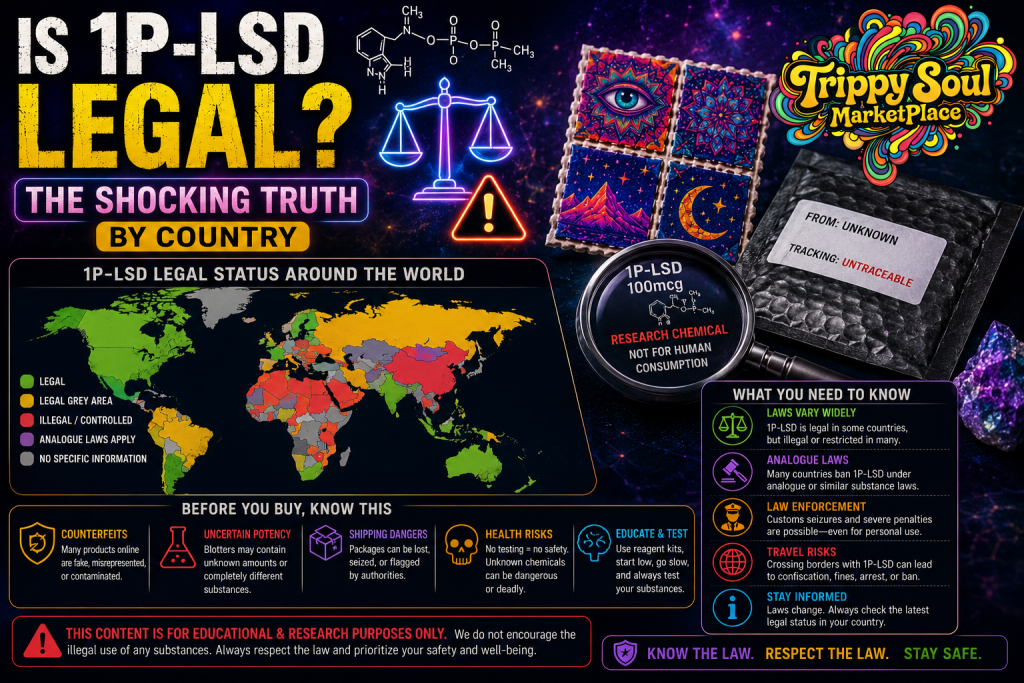
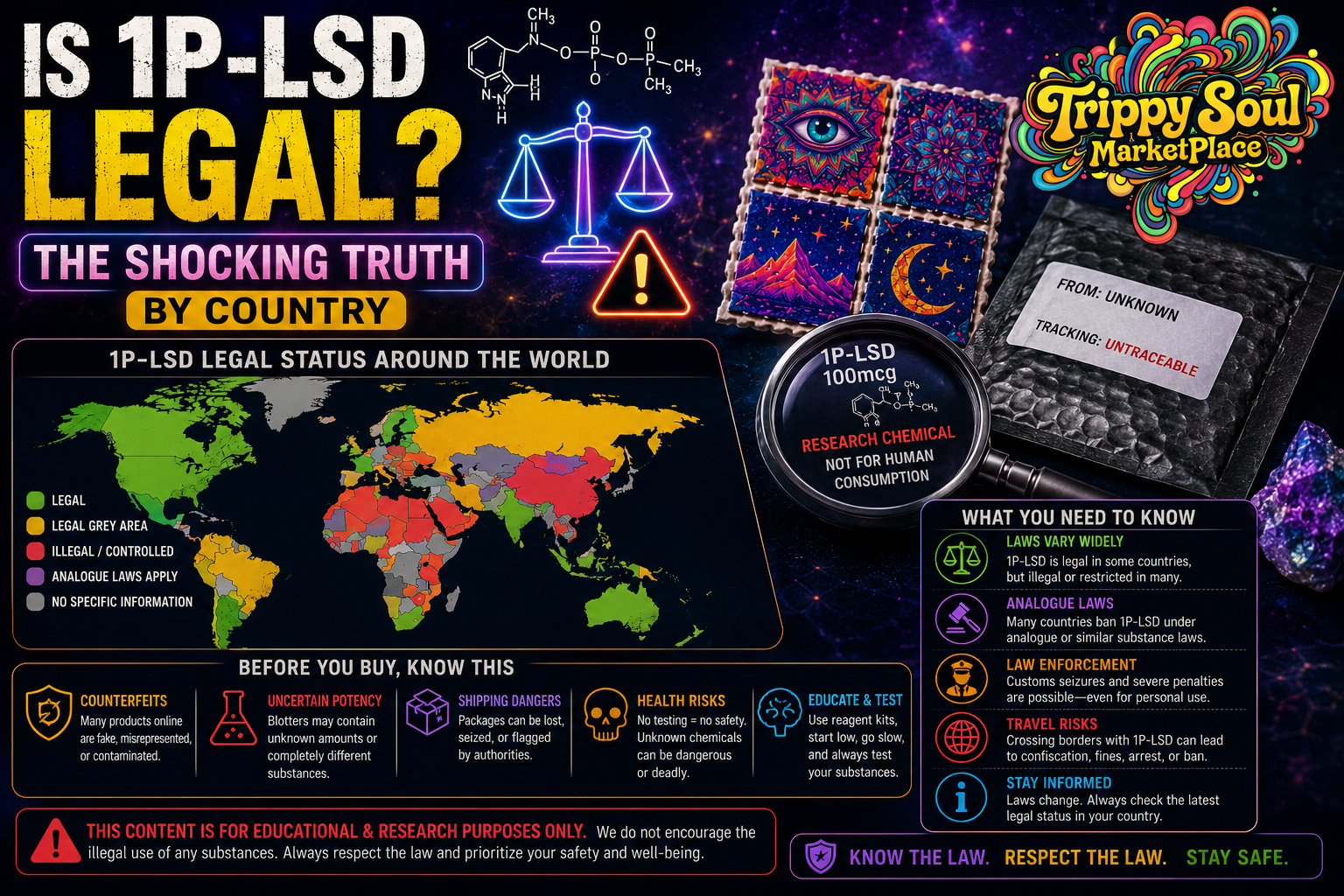
Is 1p-lsd legal? The honest answer is that it depends entirely on where you live, and even then, the situation can shift within a single legislative session. This guide breaks the question down country by country, explains why 1P-LSD’s legal status is so inconsistent globally, and covers what “legal to buy” actually means once shipping, customs, and enforcement enter the picture.
Why “Is 1P-LSD Legal” Doesn’t Have One Answer
1P-LSD is a lysergamide research chemical designed, at least originally, to sit just outside existing drug laws by using a slightly different chemical structure than LSD itself. That strategy worked for a while precisely because most drug schedules name specific molecules rather than entire chemical families. Lawmakers wrote LSD into law decades ago, long before chemists synthesized 1P-LSD, so the newer compound simply wasn’t covered by name. (1p-lsd legal status)
Because legislatures move slower than chemistry labs, this gap between compound and law is common across the broader novel psychoactive substance category, not unique to 1P-LSD. Some countries responded by banning substances individually as they appeared. Others rewrote their laws entirely to cover structural classes or “psychoactive effect” broadly, closing the loophole in one motion rather than chasing each new molecule one at a time.
United States: The Federal Analogue Act Explained
In the United States, 1p-lsd status sits in a genuinely ambiguous space. The compound isn’t explicitly named in the federal Controlled Substances Act schedules in most circumstances. However, the Federal Analogue Act allows prosecutors to treat a substance as equivalent to a scheduled drug if it’s considered structurally or pharmacologically similar and intended for human consumption. Because LSD is a Schedule I substance, 1P-LSD’s close structural relationship makes it a plausible target for analogue prosecution.
Courts have tested that legal theory before, with mixed outcomes depending on the specifics of each case. Prosecutors generally need to show both structural similarity and evidence that someone intended a substance for consumption rather than “research,” which is why so much marketing in this space leans on that legal-sounding disclaimer. In practice, that label offers far less protection than vendors imply, since courts look at actual circumstances rather than packaging language alone. (1p-lsd legality by country)
State law adds another layer of complexity. Some states have moved independently to schedule 1P-LSD or broader lysergamide categories, meaning a compound’s status can differ from one state to the next even within the same country. Anyone trying to answer is 1p-lsd illegal in their specific location needs to check both federal and state law, since either level can create legal exposure independently.
Europe and the UK: Where the Law Moved Fastest
Several European countries reacted to 1P-LSD’s popularity far more directly than the United States did. Germany added it explicitly to its New Psychoactive Substances Act in 2015, closing the loophole almost as soon as the compound became visible in online markets. Multiple neighboring countries followed with similar targeted bans within a few years, treating it much like they’d treated earlier lysergamide analogs before it.
The United Kingdom took a broader legislative approach entirely. Rather than naming individual compounds one at a time, the Psychoactive Substances Act criminalizes the production, supply, or importation of any substance capable of producing a psychoactive effect, with only a specific list of exemptions such as alcohol, caffeine, and approved medicines. Under that framework, whether 1P-LSD appears by name in the law becomes almost irrelevant, since the law was written specifically to close exactly this kind of naming loophole.
Because EU member states don’t share fully uniform drug law, 1p-lsd legality by country still varies meaningfully even within Europe. Some nations maintain narrower, name-based schedules that haven’t caught up to newer lysergamide analogs, while others adopted broad analogue provisions similar to the UK’s approach. That inconsistency means a compound’s legal status can change the moment someone crosses a border, regardless of intent.
Does “For Research Purposes Only” Actually Change Anything?
Many vendors label 1P-LSD listings as being sold strictly “for research purposes,” and that phrase gets treated online as though it carries real legal weight. In practice, it usually doesn’t. Courts generally look at the actual circumstances surrounding a sale, including packaging, marketing language, dosage information, and typical use patterns, rather than accepting a disclaimer at face value.
That distinction matters because a label alone was never designed to grant legal immunity; it was designed to reduce a vendor’s liability while shifting risk toward the buyer. Genuine research chemical sales to laboratories or universities look nothing like a website selling small blotter quantities to individual consumers with same-day shipping. Because that difference is usually obvious to a prosecutor, the “research only” framing tends to hold up far better in marketing copy than it does in an actual courtroom.
Some jurisdictions have gone further and explicitly closed this loophole in their legislation, treating any sale intended for human consumption as falling under standard drug law regardless of how a listing describes itself. Others still allow the ambiguity to persist, either due to slower legislative processes or genuine legal gray area that hasn’t been tested yet. Either way, buyers relying on that label as a legal shield are working from a weaker foundation than most vendor marketing suggests.
Canada, Australia, and Beyond
Canada’s Controlled Drugs and Substances Act doesn’t name 1P-LSD explicitly in most public interpretations, but Canadian law also includes analogue-style provisions that can apply to structurally similar compounds, echoing the same legal uncertainty seen in the United States. Australia takes a comparatively aggressive stance through its own psychoactive substances legislation, which, similar to the UK model, targets broad categories rather than relying solely on named compounds.
Across much of the rest of the world, the pattern repeats with local variation: some countries have addressed lysergamide analogs directly, others rely on broader interpretations of existing controlled substance law, and a smaller number genuinely lack clear regulation either way. That absence of explicit regulation doesn’t grant permission, since prosecutors in many of these places can still pursue charges under general drug trafficking or public health statutes even without a substance-specific law.
Why 1P-LSD’s Legal Status Keeps Changing
Drug law rarely stays static once a substance draws public or media attention, and 1P-LSD has drawn plenty of both over the years. Regulatory bodies typically respond to a combination of factors: reported hospitalizations, media coverage, law enforcement pressure, and international coordination between countries trying to close loopholes simultaneously. As a result, 1p-lsd schedule status in any given country counts only as a snapshot, not a permanent fact.
Because enforcement priorities shift independently of the underlying law, even a technically unchanged legal status can feel very different in practice from one year to the next. A country that rarely enforced its analogue laws in the past might suddenly increase prosecutions following a policy shift, a change in political leadership, or a high-profile incident involving a related compound. Consequently, older forum posts or outdated vendor claims about legality never count as current information.
What “Legal to Buy” Doesn’t Actually Mean
Even in places where 1P-LSD isn’t explicitly scheduled, buying it online rarely means the transaction is entirely risk-free. International shipping introduces customs law as a separate legal layer, and a package can be intercepted, seized, or flagged for investigation regardless of whether the substance is technically legal in the buyer’s home country. Some countries treat undeclared substances crossing their border as an independent offense, separate from whatever domestic scheduling status the substance holds.
Because mail interception can escalate from simple confiscation to a formal investigation, particularly with larger quantities, buyers sometimes face consequences even in genuinely gray-area jurisdictions. Vendors operating legally in their own country have no ability to protect a buyer from enforcement action somewhere else entirely, which is exactly why “the website says it’s legal” offers far weaker protection than it appears to on the surface.
Penalties: What Happens If Someone Is Caught
Penalties for 1P-LSD possession or distribution vary enormously depending on jurisdiction, quantity, and whether prosecutors pursue analogue or broader psychoactive substance charges. In countries with explicit bans, penalties often mirror those for comparable controlled substances, ranging from fines to significant prison time for distribution-level quantities. In countries relying on analogue laws, penalties can be harder to predict, since much depends on how a court interprets structural similarity and intent in a specific case.
Distribution and trafficking charges generally carry far more severe consequences than simple possession almost everywhere, and quantity thresholds that trigger those more serious charges vary by country as well. Anyone concerned about legal exposure should treat uncertainty itself as a risk factor, since unclear law doesn’t necessarily translate into lenient enforcement, and assuming otherwise has led to real legal consequences for people who believed a gray area meant safety.
Sentencing guidelines also differ sharply between countries that treat drug offenses primarily as a criminal matter and those that lean toward treatment-focused or decriminalized approaches for personal-use quantities. A first-time offense involving a small personal amount might result in a fine or diversion program in one country, while the same scenario triggers a criminal record or worse elsewhere. That variation makes blanket assumptions about consequences especially unreliable across borders.
Frequently Asked Questions
Is 1p-lsd legal in the United States? It’s not explicitly scheduled federally in most cases, but the Federal Analogue Act can still apply because of its structural similarity to LSD, a Schedule I substance. Some states have also moved to schedule it independently.
Is 1p-lsd illegal everywhere in Europe? No, but many countries, including Germany, have banned it explicitly, and the UK’s Psychoactive Substances Act effectively criminalizes it without naming it directly. Legal status still varies meaningfully by country.
What is 1p-lsd’s schedule classification? There’s no single global classification. Some countries schedule it directly alongside other controlled lysergamides, others apply broader analogue or psychoactive substance laws, and a few have no explicit rule covering it at all.
Does legality where I live protect me if I order 1p-lsd online? Not necessarily. Customs and mail interception operate as a separate legal risk from domestic scheduling, and a package can still be seized or investigated even in a jurisdiction with unclear or permissive law.
Conclusion
Ultimately, is 1p-lsd legal is a question with dozens of different answers depending entirely on location, and that inconsistency is unlikely to resolve any time soon. Newer analogues will likely continue to appear as regulators close each existing loophole, repeating a pattern that’s played out with 1P-LSD and its predecessors for over a decade now. Anyone treating a single search result, an old forum post, or a vendor’s own claim as a final answer is working with far less certainty than the confident phrasing usually suggests.
Staying informed isn’t about encouraging use; it’s about reducing preventable legal and health harm for people who are going to research this topic regardless. Anyone with questions about their own situation should consult current local law directly, and anyone concerned about their own use, or a loved one’s, can reach out to a local harm reduction organization or a medical professional for confidential support.