
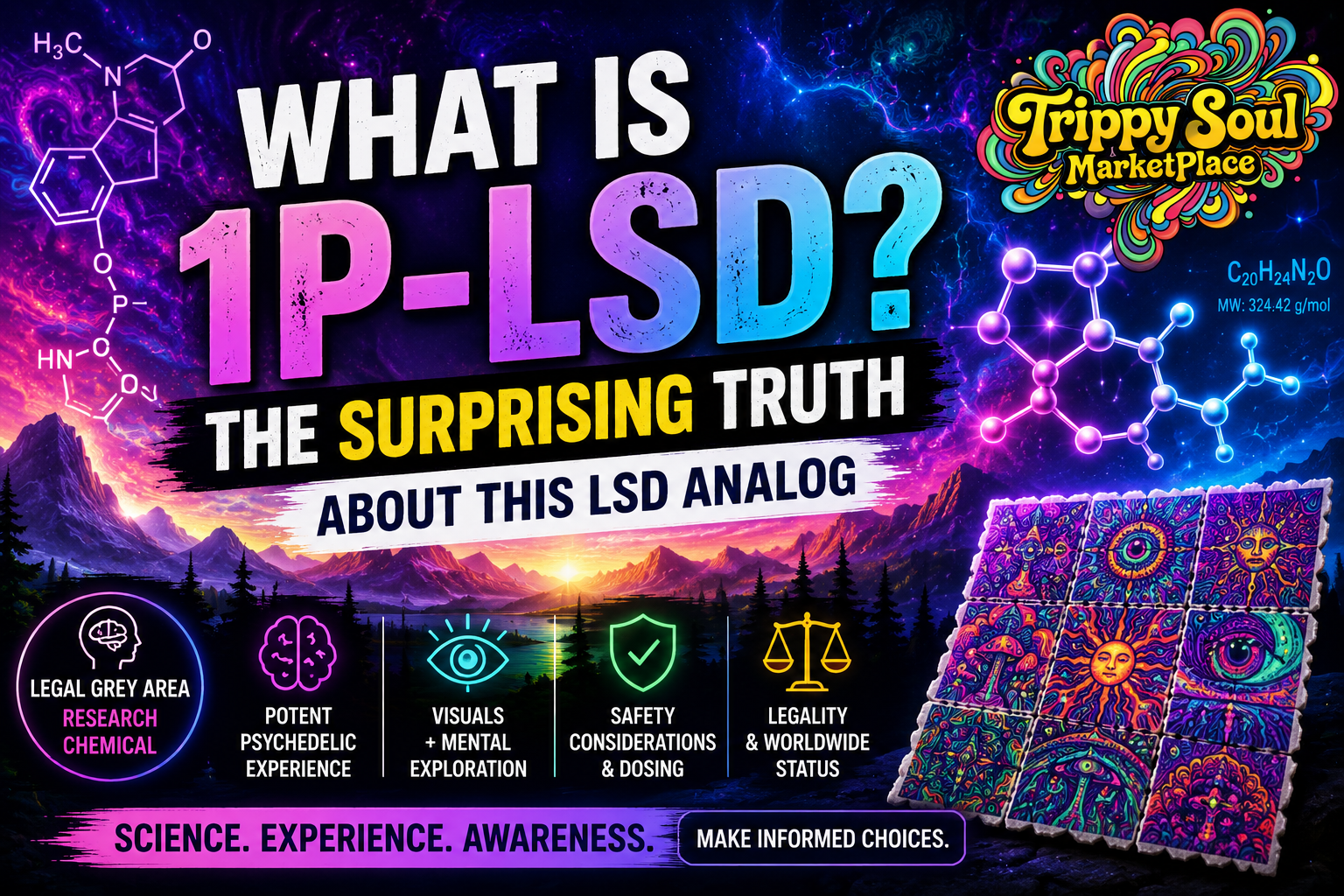
What Is 1P-LSD? The Surprising Truth About This LSD Analog
Table of Contents
People searching what is 1p-lsd are usually trying to make sense of a compound that shows up constantly in research chemical marketplaces, yet rarely gets covered with real accuracy. This guide breaks down the chemistry, the legal history, how it compares to classic LSD, and what genuine harm reduction looks like for anyone researching it.
What Is 1P-LSD?
1P-LSD, short for 1-propionyl-lysergic acid diethylamide, is a lysergamide research chemical structurally related to LSD. Chemists consider it a prodrug, meaning the body is thought to metabolize it into LSD itself after it’s absorbed. That relationship is why so many descriptions of 1P-LSD lean heavily on LSD’s own research history, even though researchers haven’t studied 1P-LSD as a distinct molecule nearly as extensively.
1P-LSD first gained attention around 2015, when it emerged in online research chemical markets as one of several lysergamide analogs designed to sit outside existing drug schedules. Because it wasn’t named explicitly in most countries’ laws at the time, vendors could sell it openly, often marketing it as “for research purposes only.” That framing rarely reflected how people were actually using the compound, but it provided legal cover in jurisdictions that hadn’t yet caught up to the chemistry.
Why 1P-LSD Became So Popular Online
Part of why what is 1p-lsd became such a common search query comes down to how research chemical marketplaces operate. Because 1P-LSD wasn’t explicitly named in most drug schedules for several years, vendors could list it openly on sites that would never touch classic LSD directly. As a result, it became one of the most visible LSD analogs of its era, discussed openly on forums where actual LSD sourcing rarely was.
However, “openly available” and “well understood” are two very different things, and that gap is exactly where confusion tends to grow. Marketing copy on vendor sites often borrowed credibility from LSD’s decades of documented use, even though 1P-LSD itself hadn’t been through anywhere near the same level of scientific scrutiny. Meanwhile, online review culture tended to amplify positive anecdotes while quieter, negative experiences went underreported, since people who have a rough experience generally post about it less than people who don’t.
In addition, the patchwork of international law meant 1P-LSD could be legal to purchase in one country and illegal to import into a neighboring one, creating legal risk that had nothing to do with the chemistry itself. Because enforcement priorities shift constantly, what was true about 1P-LSD’s legality a few years ago isn’t necessarily true today. Consequently, treating “currently unregulated somewhere” as a permanent status was always a mistake, and it remains one for anyone researching similar analogs now.
The Chemistry Behind the Prodrug
Understanding what is 1p-lsd chemically means understanding the propionyl group attached to the LSD molecule. Researchers believe that small structural addition changes how the body processes the compound, delaying activation until enzymes in the body cleave the propionyl group away, leaving something functionally very close to LSD itself. Because this conversion happens internally rather than instantly, onset can feel slightly slower or different compared to LSD taken directly.
Limited pharmacokinetic research exists on this conversion process specifically. Most of what’s understood comes from analytical chemistry studies and user-reported experience rather than controlled clinical trials. That gap matters: prodrug behavior can vary between individuals depending on metabolism, meaning two people could experience meaningfully different onset times or intensities from what looks like an identical dose.
1P-LSD vs LSD: How They Compare
The comparison people care about most, 1p-lsd vs lsd, largely comes down to legal history rather than dramatic differences in experience. Once metabolized, researchers believe 1P-LSD produces effects nearly indistinguishable from LSD itself, including visual distortion, altered time perception, and shifts in mood and thought patterns. However, “nearly indistinguishable” still leaves room for real variation, particularly around onset timing and individual sensitivity.
Where the two compounds diverge sharply is regulatory history. LSD has been a globally controlled substance for decades, with an extensive body of both underground use and, increasingly, clinical research behind it. 1P-LSD spent years in a legal gray zone, largely thanks to regulators not yet classifying it, which is precisely what made it attractive to vendors and buyers looking for something similar without the same legal exposure.
That gray zone didn’t last everywhere. Germany added 1P-LSD to its New Psychoactive Substances Act in 2015, and several other European countries followed with their own bans not long after. The compound’s regulatory story is really a case study in how novel psychoactive substances get discovered, marketed, and eventually restricted once lawmakers catch up to the chemistry.
Is 1P-LSD Legal? (1p-lsd legal status)
Answering this requires checking your specific location, since 1p-lsd legal status varies considerably and continues to shift. In the United States, 1P-LSD is not explicitly scheduled under federal law in most circumstances, but the Federal Analogue Act can still apply because regulators can treat it as substantially similar to LSD, a Schedule I substance. That legal ambiguity means “not named” is far from “definitely legal.”
In much of the European Union, the picture looks different. Germany, along with several other countries, moved to ban 1P-LSD explicitly after it became one of the more visible LSD analogs on the market. The United Kingdom’s Psychoactive Substances Act takes a broader approach entirely, criminalizing the supply of any substance intended to produce a psychoactive effect, regardless of whether that specific compound appears by name in the law.
Because enforcement priorities and legislation both shift over time, anyone researching 1P-LSD should verify current regulations directly rather than relying on outdated forum posts or vendor claims, since vendors have an obvious incentive to describe legality in the most favorable light possible.
1P-LSD Effects: What Gets Reported
Because 1P-LSD converts into something functionally close to LSD, reported effects mirror what’s commonly described with classic LSD: visual and auditory changes, altered perception of time, shifts in mood, and introspective or dissociative-feeling states. Onset is frequently described as slightly slower than LSD taken directly, which some users attribute to the time needed for the body to metabolize the propionyl group away.
None of that similarity should be read as a safety signal. Psychedelic effects, including those linked to 1P-LSD, can be intense and unpredictable, especially for people with a personal or family history of psychosis or certain cardiovascular conditions. Set and setting, meaning someone’s mental state and physical environment, strongly shape how any psychedelic experience unfolds, and a stressful or unfamiliar environment can meaningfully raise the odds of a difficult experience.
Health and Safety Risks
The core safety concern with 1P-LSD isn’t unique to the molecule; it’s the broader unregulated market surrounding it. Because formal oversight is limited, purity verification is genuinely difficult, and mislabeled or inconsistent products do circulate among vendors. Reagent tests built for LSD can offer partial reassurance, but a positive reaction doesn’t confirm exact concentration or rule out contamination entirely.
Psychological risk deserves particular attention here. Difficult psychedelic experiences, sometimes called challenging trips, remain a real possibility with any lysergamide, 1P-LSD included. These experiences can involve intense anxiety, paranoia, or lingering emotional distress well after the physical effects fade. People with a personal or family history of psychiatric conditions, especially psychosis or bipolar disorder, face meaningfully elevated risk and should weigh that seriously before considering use.
Physical risk is generally considered lower than with many other substance categories, though it isn’t absent. Elevated heart rate and blood pressure get reported fairly often, which matters for anyone managing an existing cardiovascular condition. Blotter or liquid dosing is inherently imprecise outside a lab setting, so the chance of an unexpectedly strong experience stays higher than with a pharmaceutical-grade product.
A handful of 1P-LSD samples have also been found mislabeled entirely, containing a different lysergamide or no active compound at all. This kind of mismatch has been documented by several independent testing services over the years. Independent testing services exist specifically to catch that kind of mismatch, and results are generally posted publicly for anyone researching a particular vendor or batch.
Harm Reduction for 1P-LSD
Given the uncertainty involved, a handful of harm reduction habits meaningfully lower risk for anyone determined to research or use 1P-LSD regardless of its legal status. Sourcing from a vendor that provides independent lab testing, where available, reduces the odds of an unexpected substance entirely. Never use alone, and make sure a sober, trusted person stays present in case something goes wrong.
Environment matters enormously with any psychedelic experience. A calm, familiar, low-stress setting reduces the odds of a frightening or overwhelming reaction, especially for anyone newer to lysergamides in general. Avoiding combination with other substances, including alcohol, stimulants, or additional psychedelics, lowers the risk of interactions that are even harder to predict with a less-studied compound like this one.
Timing deserves real attention too. Because onset can feel slower or less predictable than with LSD, some users redose too early, mistakenly believing the first dose failed. That mistake can lead to an unexpectedly intense combined effect once both doses activate together. In short, patience functions as a genuine harm reduction tool here, not just a suggestion. Furthermore, keeping a simple written log of source, timing, and effects can help someone recognize a problematic batch before it causes wider harm to others buying from that same source.
Anyone with a personal or family history of psychosis, certain heart conditions, or uncontrolled high blood pressure should treat that history as a serious reason for added caution, since psychedelic experiences can worsen underlying conditions unpredictably. If a difficult psychological reaction happens, calm reassurance, a quiet space, and a trusted person nearby can genuinely help; if physical symptoms like chest pain, severe confusion, or loss of consciousness appear, emergency medical help should be sought right away.
Frequently Asked Questions
What is 1P-LSD? 1P-LSD is a lysergamide research chemical that researchers believe the body metabolizes into LSD itself. It circulated widely as a legal alternative to LSD before several countries moved to ban it explicitly.
Is 1p-lsd vs lsd effects the same? Once metabolized, reported effects are described as very similar, though onset timing and individual sensitivity can vary. Formal research remains limited, so direct comparisons should be treated as rough rather than precise.
What is 1p-lsd legal status in most countries? It varies significantly. Some countries, including Germany, have banned it explicitly. Others, like the United States, don’t name it directly but can still apply broader analogue laws. Checking current local regulations is essential before assuming anything.
Does a 1p-lsd blotter carry the same risks as an LSD blotter? Largely yes, plus added uncertainty. Blotter paper dosing is inherently imprecise for both substances, and because 1P-LSD is less studied and less consistently regulated, purity and concentration verification is generally harder to obtain.
Conclusion
Ultimately, understanding what is 1p-lsd means understanding a compound built almost entirely around LSD’s own chemistry and cultural history, just with a different legal story attached. Its similarity to LSD doesn’t erase the real uncertainty around purity, dosing, and long-term research that still surrounds it, and that uncertainty deserves serious respect from anyone researching the compound.
Staying informed isn’t about encouraging use; it’s about reducing preventable harm for people who are going to seek this information regardless. Anyone with questions about their own use, or a loved one’s, can reach out to a local harm reduction organization or a medical professional for confidential support and guidance.